You need to talk to someone and don't want to bother anyone
It's three in the morning, you're circling the same thoughts, and you don't want to text your ex or wake your best friend again. These are the options that actually exist, and what each one can give you.
Who can you talk to at three in the morning?
At that hour three doors are still open: an anonymous community, a support chat that runs 24 hours, and a crisis line if thoughts of hurting yourself appear. None of them is therapy, but any of them gets you through the night without texting your ex.
Nothing about your breakup changes at three in the morning: everything else has switched off, leaving your head alone with the subject. The mistake at that hour isn't saying too much, it's saying nothing to anyone and ending up texting your ex.
What are the options, and what can each one do?
There are six real options: friends and family, anonymous communities, AI support chats, support groups, therapy, and crisis lines. Picking the wrong door is what leaves people convinced that talking doesn't help.
| Option | What it gives you | What it isn't |
|---|---|---|
| A friend or your family | Being heard by someone who knows you | Not impartial, not always available |
| Anonymous community | Writing what you'd never post under your name | Not an instant reply or one-to-one attention |
| AI support chat | Sorting out what you feel at any hour | Not a person and not a professional |
| Support group | A fixed slot each week, with others in it | Not 24 hours: it has a schedule and limited places |
| Therapy | Understanding why it hurts and seeing the pattern | Rarely immediate or free |
| Crisis line | Urgent help if you think about hurting yourself | Not for talking through grief day by day |
The healthiest setup is not depending on one of them: a friend for the connection, somewhere anonymous for the small hours, therapy when it's possible.
Does talking to an AI about a breakup help?
It helps with three things: offloading whatever you're feeling at any hour, turning a knot inside you into actual words, and interrupting an urge when you're about to text your ex. It doesn't diagnose you and it doesn't replace someone who knows you.
People end up talking to an AI after a breakup not because of the technology: at that hour you're not waking anyone, and you can tell the same story for the tenth time. Writing also forces you to name it, and "I feel awful" almost always turns out to be something more specific — anger, humiliation, fear.
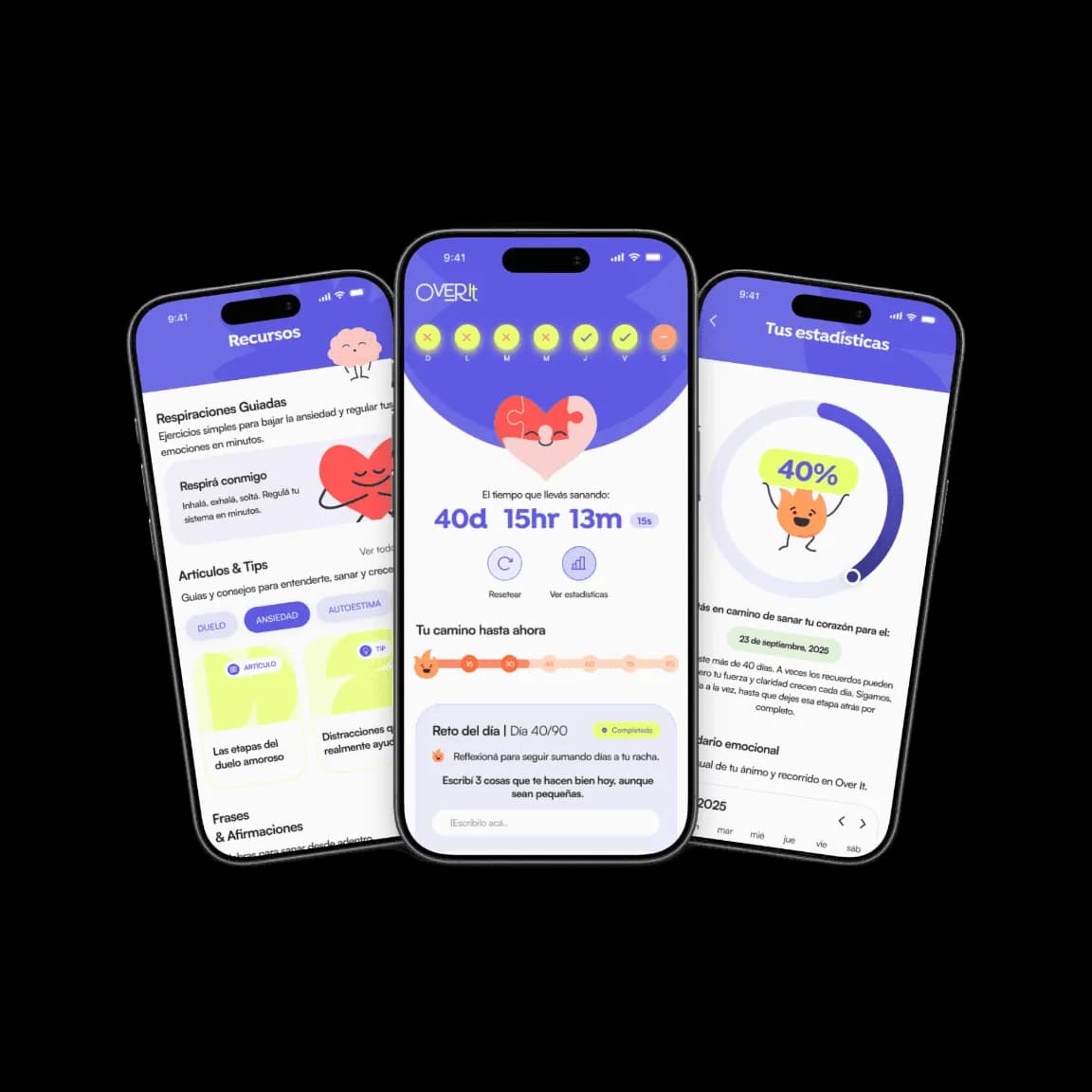
In Over It that place is called Ninety: a support chat available 24 hours, in English or Spanish. It's an AI character, not a person and not a therapist, and it can get things wrong.
- Not for telling you whether you have depression: that's for a professional who actually sees you.
- Not as your only relationship: if a screen is all you've talked to for weeks, that's a data point.
- Not in an emergency: if you're at risk, the place is a crisis line.
Who do I talk to if I don't want to bother my friends?
The sense that you're being a burden almost never comes from your friends complaining — it comes from you. It's fixed by spreading the load and asking concretely: "Do you have twenty minutes?" gets far more than "sorry for being exhausting again".
What wears a friend out isn't your breakup, it's not knowing what's expected of them. If they can't tell whether they're supposed to solve it or just listen, they'll do both badly.
- 1
Say up front what you need
"I don't need advice, I just need to say it out loud." It takes the pressure of fixing your life off them.
- 2
Spread it across three people, not one
With a single person you'll feel like you're burning them out, and you're probably right. Across three, none of them runs dry.
- 3
Leave the small hours to another channel
Three in the morning isn't friend hours: that's what the anonymous and the always-open options are for.
What can you do if you can't afford therapy?
Three concrete routes exist in most places: mental health services through the public health system, university psychology clinics where supervised trainees see the public at low cost, and private therapists who hold sliding-scale slots. None of them is instant, but all three are real and you get them by asking.
- Public health services. Most public systems have mental health provision and many let you refer yourself. Put your name down even if there's a wait: it starts the day you register.
- University training clinics. A lot of psychology departments run clinics open to the public, staffed by trainees under academic supervision, at low cost or free.
- Sliding scale. Plenty of private therapists keep a few reduced-fee places and never advertise them. Ask. The worst that happens is they say no.
- Your insurance or your workplace. Many plans cover sessions a year that people never use because they never asked.
A grief group or a workshop costs a fraction of an individual session. And meanwhile the free things aren't nothing: sleeping, moving, eating, and having somewhere to go at three in the morning. Over It sits there: it isn't therapy and it doesn't replace the appointment you're waiting for.
Frequently asked questions
Where can I talk about my breakup anonymously?
In anonymous communities inside support apps, in breakup and grief forums, and in support chats that never ask you to identify yourself. Pick moderated spaces and don't move into private messages with strangers. Over It has an anonymous community inside the app: you post without a name or a photo.
What do I do if I can't afford therapy?
Try three doors before you write it off: public health mental health services, university psychology clinics that see the public at low cost under supervision, and asking private therapists whether they hold sliding-scale slots. Check your insurance or workplace scheme too: a lot of people have covered sessions they've never used.
Is it bad that I keep telling the same story over and over?
No. Repeating the story is how grief processes it — each retelling reorders it slightly. The problem isn't repeating, it's repeating with the same person until they're worn out.
You're going through a breakup. You're not in this alone.
Over It is a guided path out of a broken heart, one day at a time.
Keep reading
- About Over It10 min
If you're in crisis, this comes first
Read the guide - Relationships5 min
You want to text them: what to do in the next twenty minutes
Read the guide - Anxiety5 min
It's 3am and you can't sleep
Read the guide - About Over It7 min
What Over It is and what it actually does
Read the guide - Tools5 min
Breakup apps in 2026, compared honestly
Read the guide