The breakup glossary
Twenty-four words that show up when something ends, explained one by one. No diagnoses, no detours: what each one means and how it feels from the inside.
Why does naming what you're going through help?
Naming what you're going through after a breakup separates the experience from your identity. Once something has a name it stops being "I'm losing my mind" and becomes a known thing, with a shape and an edge, that has already happened to a lot of people. Naming doesn't fix anything on its own, but it lowers the intensity enough that you can think again.
At three in the morning the problem is rarely information. It's that what you're feeling feels unique, enormous and edgeless. A precise word gives it edges.
This glossary has twenty-four entries. Each one reads on its own, in any order. Find the one that sounds like you and skip the rest.
| What you're living through | What it's called |
|---|---|
| They disappeared without a word | Ghosting |
| They don't speak to you, but they watch every story | Orbiting |
| They surface every so often with one message and nothing more | Breadcrumbing |
| You were something, but it was never called a relationship | Situationship |
| You can't stop replaying the same conversation | Rumination |
| You check their profiles several times a day | Stalking an ex online |
| They treated you badly and you still want them back | Trauma bond / intermittent reinforcement |
| You know it's over, but it doesn't feel over | Ambiguous loss |
What is ghosting?
Ghosting is when someone you had a connection with disappears completely and without explanation: they stop answering messages and calls, and give no reason. There's no argument, no conversation, no ending. It hurts differently from a breakup that was spoken out loud, because it leaves nothing to understand, and your head tries to fill that gap with explanations nobody ever confirms.
The hardest part of ghosting isn't the absence: it's that there's no full stop. With no version of events, the mind keeps working on a file that never closes, and that search can run for months.
Ghosting says far more about the other person's capacity to sit through an uncomfortable conversation than about your worth. It's an exit through avoidance, and avoidance belongs to the one who left, not to the one still waiting.
What is orbiting?
Orbiting is when someone cuts off direct contact but keeps showing up on your feed: they watch every story, leave the occasional like, react to a photo, and never write. It's ghosting with a visible presence. They keep you in orbit — close enough that you can't forget them, far enough that nothing can actually happen.
Orbiting is hard to let go of because every view resets the clock. Just when you'd gone four days without thinking about them, their name appears at the top of a story and your body reacts as if something had changed. Nothing changed.
Muting stories, restricting the account or blocking isn't an act of aggression: it's taking a signal off the air that keeps you on alert. No contact also covers what the other person gets to see of you.
What is a situationship?
A situationship is a connection that works like a relationship but that nobody ever named as one: there's intimacy, routine, plans and often de facto exclusivity, but no agreement and no definition. When it ends it hurts as much as a relationship does, with the added weight that the people around you don't recognize the grief, because "technically you weren't anything".
The missing definition isn't an administrative detail. It's what stops you asking for more, what stops you introducing them, and later what stops you grieving out loud. You lost something real and on top of that you have to argue about whether you had the right to lose it.
The time you spent together, the things you told each other, the things you planned — all of that existed. The absence of a label erases none of it.
What is love bombing?
Love bombing is a flood of attention, gifts, plans and declarations at the start of a relationship, so intense and so fast that it skips every normal stage of getting to know someone. It isn't the same as falling hard. Love bombing is recognized by what comes after: the intensity is pulled away all at once and distance, criticism or coldness takes its place.
The problem isn't the intensity itself. It's the contrast. When the level of attention drops off a cliff, the body reads it as an enormous loss and starts doing whatever it takes to get the earlier state back.
If you look back and remember an unreal first month followed by months of trying to return to that first month, you already know what this is.
What is limerence?
Limerence is a state of involuntary romantic obsession: intrusive thoughts about one person, extreme sensitivity to any sign that they feel the same, and an urgent need for reciprocation. Psychologist Dorothy Tennov coined the term in 1979, in her book Love and Limerence. It isn't settled love; it's a state of very high activation that feeds on uncertainty.
The practical difference from love is where the attention sits. In love, what matters is the person. In limerence, what matters is the person's response: the message, the gesture, the confirmation.
- You think about that person many times a day, without choosing to.
- You read every small gesture as a sign that they feel the same, or that they don't.
- The image you hold is idealized: the flaws don't get in, or they get explained away.
- The intensity rises when there are obstacles and drops when there's certainty.
- Relief doesn't come from closeness, it comes from confirmation.
Limerence burns out with real information and with time and no new signals. That's why orbiting hurts so much: it keeps the uncertainty switched on.
What is rumination?
Rumination is repetitive, circular thinking about the same thing: replaying the last conversation, hunting for the exact moment it broke, imagining what you would have said. It feels like solving something, but it never reaches a conclusion and usually leaves you worse than when you started. It's one of the engines that keeps a breakup alive long after the last contact.
The trap is that rumination dresses up as analysis. Analysis ends in an answer; rumination ends in the same question, again, a little later.
One way to tell them apart: if you've gone around the same subject three times and no new fact has appeared, you're not thinking, you're spinning. How to stop thinking about your ex has concrete ways to break the loop.
What is no contact?
No contact is the decision to cut off all contact with your ex for a defined period: no messages, no calls, no checking their profiles, no asking mutual friends how they're doing. It isn't a punishment and it isn't a tactic to get them back. It removes the signals that keep your nervous system waiting, so grief can actually start.
No contact doesn't work through toughness, it works through the absence of new information. Every new message restarts the process; every day with nothing new lets it move.
How to hold it, what to do about the unavoidable exceptions and why counting the days helps is in no contact and in the no contact counter.
Frequently asked questions
What is limerence, and how is it different from love?
Limerence is a state of involuntary romantic obsession, with intrusive thoughts and an urgent need for your feelings to be returned. The practical difference from love is what each one runs on: love holds steady on certainty and grows through ordinary life together; limerence runs on uncertainty and fades once the answer is clear and stable. That's why limerence intensifies when there are obstacles, and love doesn't.
What is a situationship, and why does it hurt so much?
A situationship is a connection that worked like a relationship but was never named as one. It hurts for two reasons at once: you lost something real — routine, intimacy, plans — and at the same time you have no social permission to grieve it, because as far as everyone else is concerned you weren't together. Grief with no outside recognition tends to last longer, precisely because it's carried in private.
What is a trauma bond, and how is it different from a hard relationship?
A trauma bond is the attachment that forms when the same person alternates harm and affection in cycles: distance or mistreatment, then intense reconciliation. A hard relationship can have conflict, exhaustion or plain incompatibility without that cycle. The difference is the pattern: in a trauma bond the good moments function as a reward for the bad ones, and that alternation is what makes leaving so expensive.
You're going through a breakup. You're not in this alone.
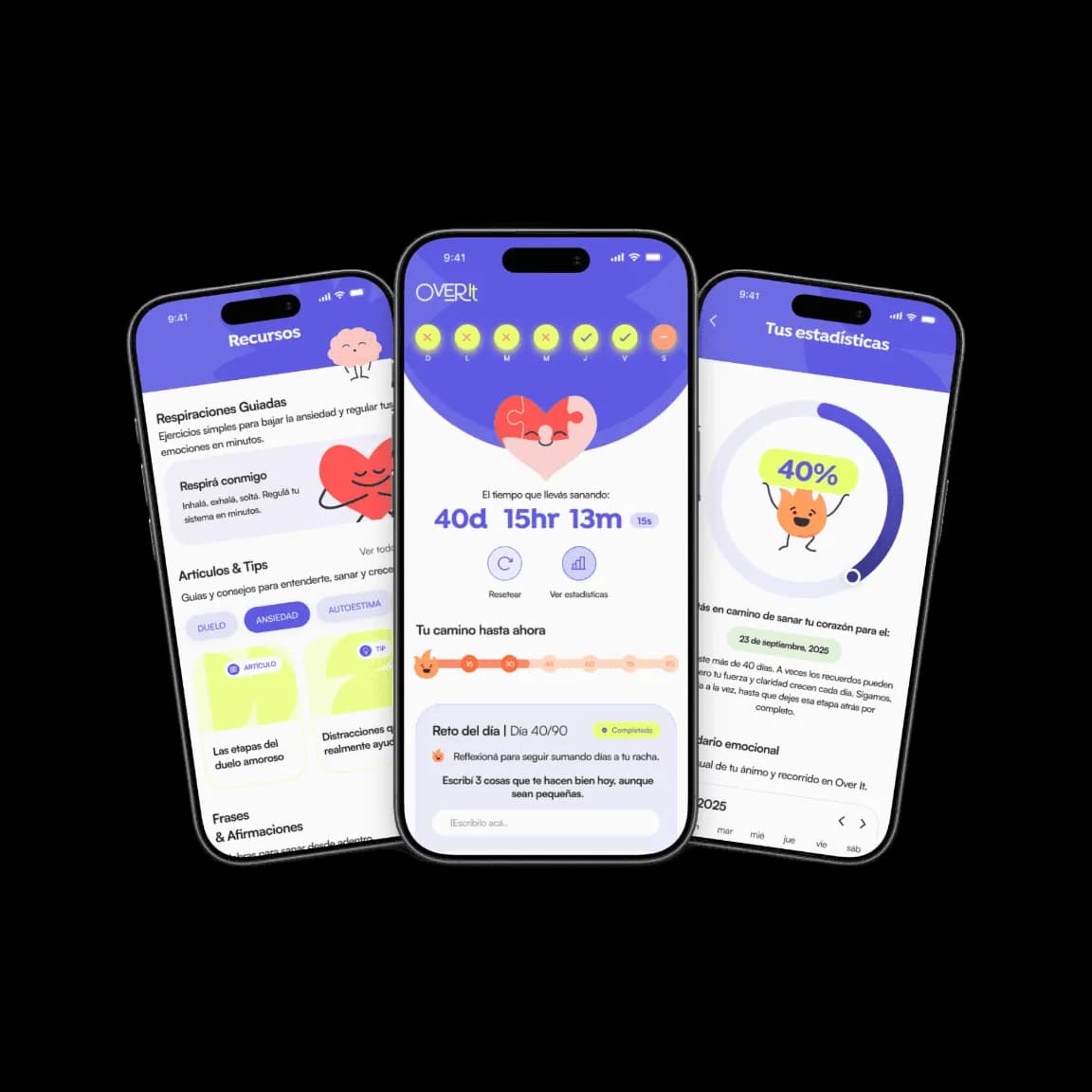
Over It is a guided path out of a broken heart, one day at a time.
Keep reading
- Relationships5 min
The no contact rule: a complete guide to starting it and holding it
Read the guide - Grief5 min
Why a breakup hurts in your body, not just your head
Read the guide - Anxiety6 min
How to stop replaying your ex in your head
Read the guide - All resourcesThe full guides by category: grief, anxiety, self-esteem and relationships.