How to stop replaying your ex in your head
Your head isn't failing you: it's doing what an attachment system does when the supply gets cut. Here are six named techniques to stop it from doing that all day.
Why can't you stop thinking about your ex?
Because your brain still treats that person as an available reward. In people who have recently been rejected, looking at a photo of the ex activates systems tied to reward, motivation and craving — the same ones described in states of withdrawal (Fisher et al., 2010). This isn't a failure of willpower: it's a search system that hasn't switched off yet.
That person was the answer to a question your brain asked many times a day: where are they, how are they. The breakup doesn't delete the question, it removes the answer, and a system without an answer searches harder. That's why it gets worse in the gaps — in the shower, the second you turn off the light — and why watching one of their stories restarts it. That's what no contact is for: not a punishment, just no longer feeding the loop.
What is rumination, and how is it different from missing someone?
Rumination is circling the same material without ever reaching a conclusion or an action. Missing someone is feeling an absence: it hurts, it rises and falls, and it changes shape over time. Nolen-Hoeksema and colleagues (2008) described it as a pattern that prolongs distress instead of resolving it.
Missing someone doesn't need fixing: it's the shape love takes when it has nowhere to go. Rumination is a mechanism, and mechanisms can be taken apart. It also carries a measurable cost: in a study of 560 people aged 17 to 22 who had recently been through a breakup (Mancone et al., 2025), it predicted worse academic performance and worse physical health.
| Missing them | Ruminating |
|---|---|
| Comes in waves and passes | Settles in and coils |
| Arrives as an image or a sensation | Arrives as questions: why, whose fault |
| It doesn't ask you to do anything | It ends up pushing you to check or to text |
Does trying not to think about your ex work?
It doesn't, and it usually makes things worse. When you decide not to think about something, part of your mind has to keep checking whether you're thinking about it, and that checking keeps the subject switched on. Wegner and colleagues documented this in 1987: people who try to suppress a thought end up having it more than people who never tried.
The original experiment is almost a joke: people are asked not to think about a white bear, and they can't. That's the rebound effect: the instruction not to think creates an internal monitor whose job is to keep the subject within reach. The people given something specific to think about instead did better: effort didn't save them, having somewhere else to go did.
What are the six techniques for breaking the loop?
The worry window (a fixed slot each day), cognitive defusion ("I'm having the thought that…"), negative reappraisal, playing the whole film, 5-4-3-2-1 grounding, and 4-7-8 breathing. None of them erases the thought: each one does something different with it.
- 1
The worry window: 15 minutes a day, at a fixed hour
Pick a fixed slot — say 7:00 to 7:15 in the evening — and make it the only stretch of the day when you're allowed to go over it. When the thought shows up outside it, you write it down in one line and answer it: seven o'clock. It comes from stimulus-control treatment for worry (Borkovec and colleagues, 1983). Never in bed.
- 2
Cognitive defusion: "I'm having the thought that…"
Say the whole sentence: not "I'll never love anyone like that again", but "I'm having the thought that I'll never love anyone like that again". It stops sounding like a verdict and becomes something your head produced.
- 3
Negative reappraisal: the honest inventory
Five things that didn't work, as scenes with specifics: not "they were distant", but "I told them I'd been laid off and they changed the subject". Langeslag and Sanchez (2018) found it lowers how in love you still are with an ex, and that it leaves your mood worse in the moment. Write it on an ordinary Tuesday, not on a Sunday night.
- 4
Play the whole film
The memory that ambushes you is cut just before the ugly part: you get the Sunday morning in bed, never the silence of the week that followed. When the good scene arrives, run it to the actual end.
- 5
5-4-3-2-1 grounding
Five things you can see, four you can touch, three you can hear, two you can smell, one you can taste. It pulls you out of the imaginary conversation and puts you back in the room you're actually in. It's for the spike.
- 6
4-7-8 breathing
Breathe in for four, hold for seven, out for eight; three or four rounds. What matters is that the exhale is clearly longer than the inhale. This is the one for the small hours, when the thought has moved into your chest.
Why do you only remember the good parts of the relationship?
Because the negative charge on a memory fades faster than the positive one. It's called the fading affect bias, and it shows up in autobiographical memory generally, not only after breakups. You're not lying: you're remembering through a filter that applies itself.
A recent study analysed more than twelve thousand memories from over two thousand adults aged 18 to 98 and found the same pattern again: negative affect fades faster and more strongly than positive affect (Hoehne and Zimprich, 2025). Your memory is not a neutral witness: when you compare "how it was with them" against "how I am now", you're comparing their edited highlight reel against your real worst week.
Frequently asked questions
Why can't I stop thinking about my ex if I was the one who ended it?
Because the loop doesn't care who ended it. Having made the decision gives you a reason; it doesn't switch off the attachment, which was built over months or years and doesn't come apart because you now have arguments.
How long does it take to stop thinking about an ex?
There's no honest number to give you: it depends on how long the relationship lasted, how much contact is still happening, and what else is going on in your life. What can be said is that frequency drops before intensity does, and that any contact restarts the clock.
Are obsessive thoughts about an ex a disorder?
In most cases, no: intense rumination after a breakup is a common response and it usually eases. If the thoughts take up most of the day for weeks, or stop you working or sleeping, talk to a professional.
You're going through a breakup. You're not in this alone.
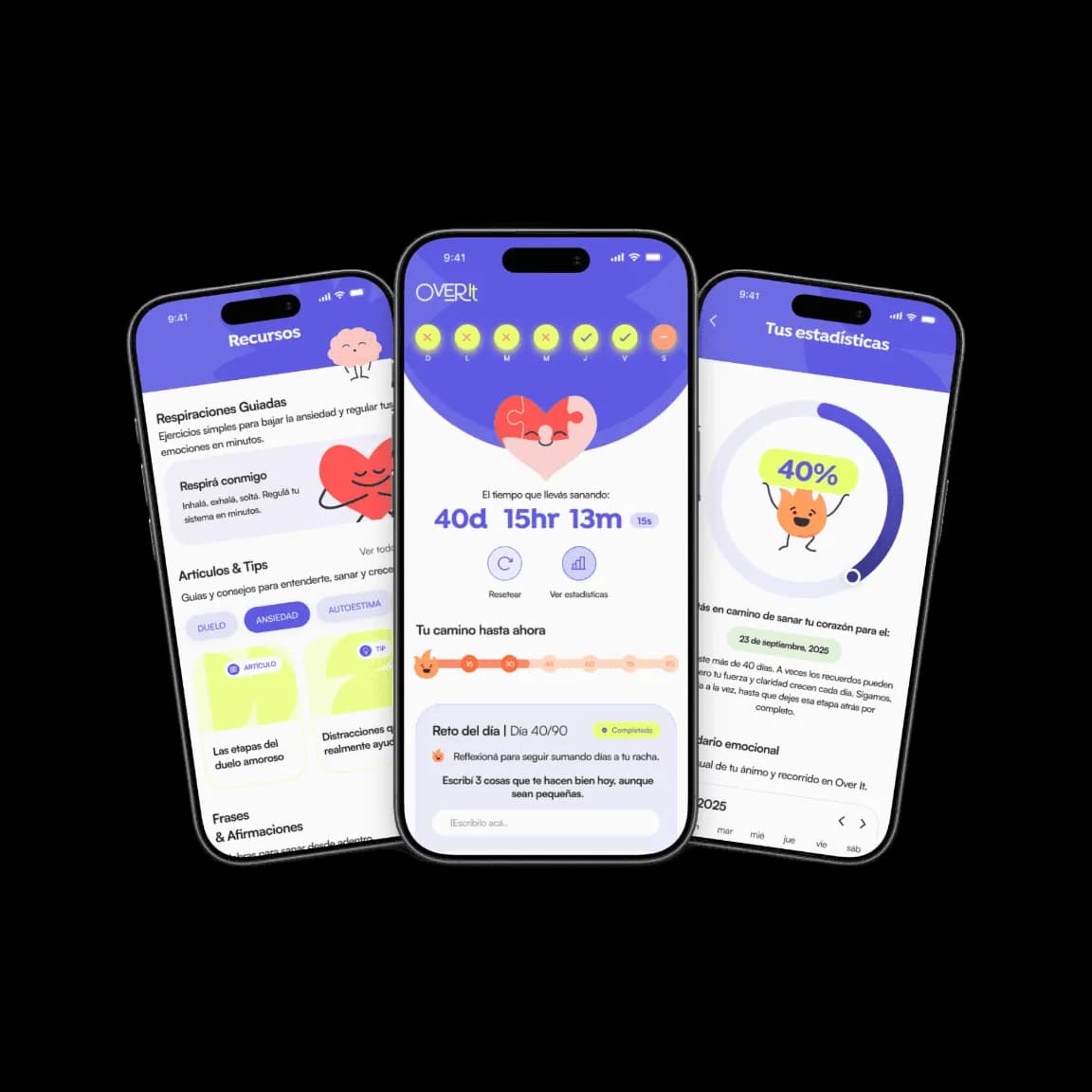
Over It is a guided path out of a broken heart, one day at a time.
Keep reading
- Relationships6 min
Block, mute, restrict or unfollow: what each one actually does
Read the guide - Relationships5 min
You want to text them: what to do in the next twenty minutes
Read the guide - Anxiety5 min
It's 3am and you can't sleep
Read the guide - Grief5 min
How long it takes to get over a breakup — and why there's no number
Read the guide - Relationships8 min
The breakup glossary
Read the guide