How long it takes to get over a breakup — and why there's no number
There's no timeline. There are badly quoted studies, a popular rule with nothing behind it, and a few fairly concrete signs that you're moving, even if it doesn't feel that way today.
How long does it take to get over a breakup?
There's no timeline. No published study gives a reliable average: the available research measured emotions day by day for a few weeks, not "recovery". What can be described is the shape: the first weeks are the most unstable, and from there the pain drops in waves rather than a straight line.
You searched for a number, and that makes sense: when something hurts every day, knowing when it ends feels like the only thing that could help today. But the number doesn't exist. What does show up tied to the pace isn't the calendar, it's contact — and that's in no contact.
Contact with the ex-partner slowed the decline of love and sadness.
What do the most-quoted studies actually say?
They measured something else. Sbarra and Emery (2005) tracked daily emotions for 28 days; Lewandowski and Bizzoco (2007) measured personal growth, not the eleven weeks people attribute to them; Morris, Reiber and Román (2015) asked 5,705 people how much pain they remembered. None of them followed anyone long enough to say how long a breakup lasts.
| Study | What it actually measured | What it doesn't say |
|---|---|---|
| Sbarra & Emery (2005). 58 people, emotional diary over 28 days. | Love, sadness, anger and relief, day by day. | Anything about what happens past the first month. |
| Lewandowski & Bizzoco (2007). 155 students. | Personal growth after leaving a relationship that wasn't giving much. | It didn't measure recovery: the eleven-week figure isn't a result of theirs. |
| Morris, Reiber & Román (2015). 5,705 people across 96 countries. | How much pain people recall feeling. | It didn't follow anyone over time: it can't measure how long anything lasted. |
A working rule: if a figure doesn't come with an author, a year and a journal, it isn't data. It's decoration.
Is it true that it takes half the length of the relationship?
No. That rule has no published study behind it: it's folk math that circulates without a source. It also fails on the obvious, because it treats every relationship as if each year weighed the same. Two calm years and two years of breaking up and getting back together don't leave the same thing behind.
What does show up tied to pace isn't duration, but how much contact you keep and how much of your identity was propped up inside the relationship. Larson and Sbarra (2015) followed 210 recently separated people for nine weeks: regaining clarity about who you are explained part of the improvement.
- A ten-month relationship can hurt more than a six-year one if it was on and off.
- Whoever makes the decision tends to report less pain than whoever receives it: in Morris and Reiber (2011), with 1,735 students, that was one of the few clear patterns.
And if you're coming out of five years, what's ahead isn't pain five times bigger: it's pain with more surface area. The flat, the routine, the friends, the plans. Wider, not longer.
Why does the pain come back in waves?
Because the emotions inside it don't fall together or at the same rate. In the diary study by Sbarra and Emery (2005), love for the ex-partner declined in a straight line, while sadness, anger and relief followed uneven curves. On top of that, each wave usually gets set off by an external cue.
Sbarra and Ferrer (2006) showed that longing, sadness and anger are distinct states that take turns: you can have a good week for sadness and a terrible one for anger. And Fisher and colleagues (2010) scanned fifteen recently rejected people who were still in love: they found activity in the reward and craving regions. That's why a wave arrives from a cue, and arrives whole.
- The times that belonged to the two of you: the morning message, Sunday afternoons.
- The ordinary places on your route, not the romantic ones: the supermarket, the bus stop.
- Alcohol, insomnia and three in the morning.
Is it normal to still feel bad at six months? What about a year?
Yes, and it's more common than people admit. When Mancini, Bonanno and Clark (2011) looked at how people do before and after a divorce, they didn't find one curve but three distinct paths. Still hurting at a year doesn't mean you're doing it wrong: it means your path is one of those.
The useful question isn't how much time has passed, but whether the shape has changed. A year of pain that got further apart and shorter is a year of progress. A year of pain that's just as constant is a different signal: not that you're broken, but that you'd do better with someone alongside you.
- The pain hasn't changed in frequency or duration in months.
- You've stopped working, seeing people, eating or sleeping the way you did.
- You're still organising your days around what that person does.
- You're drinking or using more than before to get through the night.
None of that is a diagnosis and we can't give one. It's a list to take to someone: talking to someone about a breakup covers how to start that conversation, and if today is urgent, crisis help has the numbers.
Frequently asked questions
How long does it take to get over a five-year relationship?
There's no number, and multiplying years by months doesn't work. With a long relationship the grief has more fronts open: the flat, the routine, the friends, the plans. The acute pain lasts about as long as it would after a short one; what takes longer is rebuilding the rest.
Who suffers more, men or women?
There's no solid answer. In Morris and Reiber's (2011) study of 1,735 students, the intensity of the pain was practically indistinguishable between men and women; what differed was how they described it. That men never fully recover is an interpretation the authors made of a different study, not a length of time measured in anyone.
Does no contact speed things up?
In the diary study by Sbarra and Emery (2005), contact slowed the decline of love and sadness across the four weeks of follow-up. That doesn't prove cause, but it matches what most people experience. It isn't a punishment or a tactic to get them back: it's taking your finger out of the wound.
You're going through a breakup. You're not in this alone.
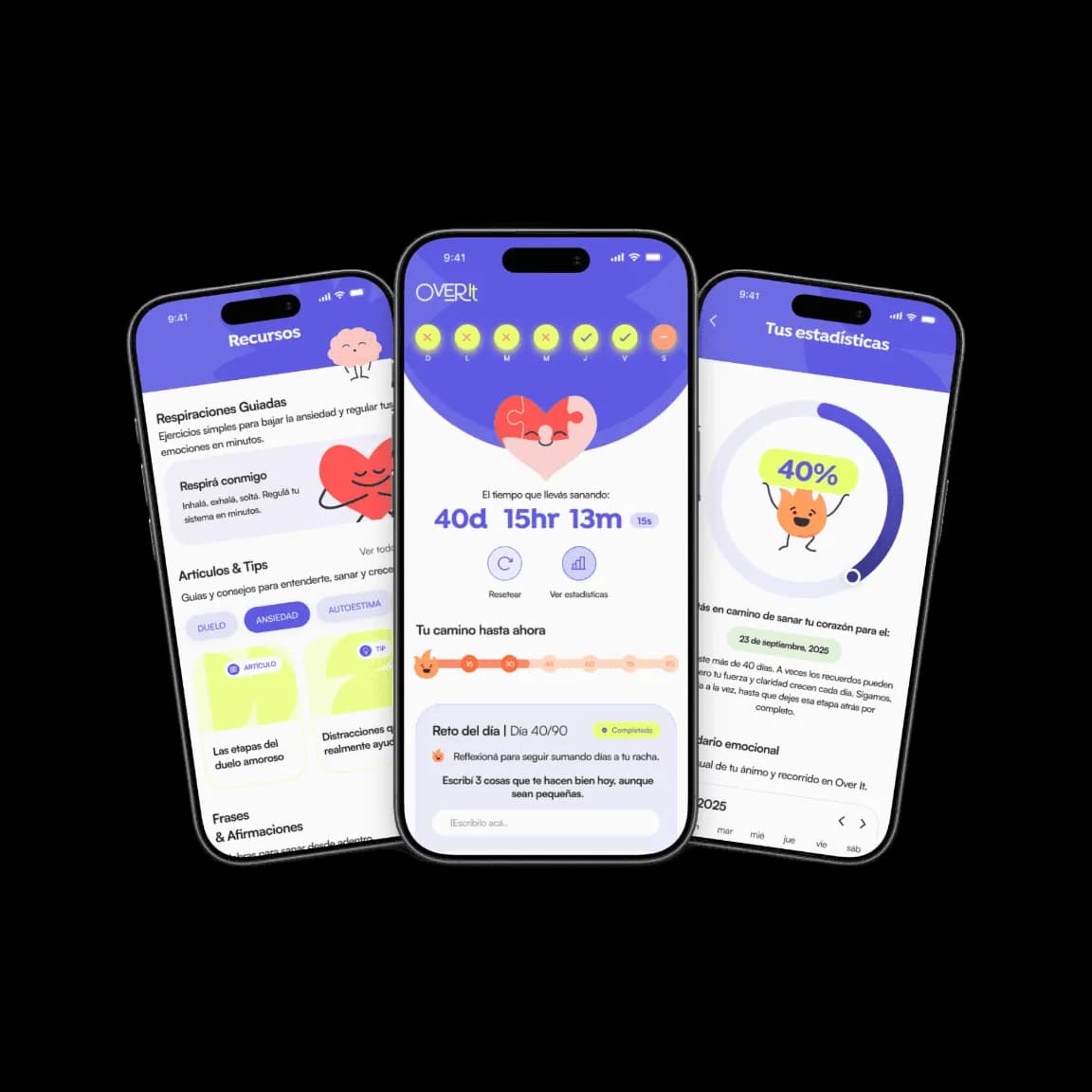
Over It is a guided path out of a broken heart, one day at a time.
Keep reading
- Grief5 min
Why a breakup hurts in your body, not just your head
Read the guide - Grief6 min
The stages of breakup grief — and why they don't go in order
Read the guide - Relationships5 min
The no contact rule: a complete guide to starting it and holding it
Read the guide - Relationships5 min
You need to talk to someone and don't want to bother anyone
Read the guide