The stages of breakup grief — and why they don't go in order
A map of what a breakup actually feels like, without the five-step staircase almost nobody climbs in order.
What are the stages of a breakup?
The stages of a breakup are usually described as six states: shock, denial, anger, bargaining, sadness and acceptance. They are not steps in a queue: they mix, they repeat, and two of them often share the same day. They are useful for naming what you feel, not for measuring whether you are behind schedule.
After a breakup, your head does not feel one thing at a time: you can miss someone and resent them within the same hour. That is not a fault in the process: that is the process.
| State | How it sounds inside your head |
|---|---|
| Shock | "It hasn't landed. It's like it happened to someone else." |
| Denial | "This is fixable. Give it days and they'll message." |
| Anger | "After everything I did for them." |
| Bargaining | "What if I explain it properly this time?" |
| Sadness | "I don't want to do anything. Nothing is any good." |
| Acceptance | "It happened. It hurts, but it isn't running my day." |
What does each stage of a breakup feel like?
Each state feels different in the body: shock numbs, denial keeps the phone in your hand, anger hands you energy and embarrassment at once, sadness takes the shape out of the day. Acceptance feels closer to boredom.
- 1
Shock
You don't sleep, you eat without noticing what, and the scene replays on a loop. It works as anaesthetic: you answer messages and nothing lands.
- 2
Denial
Not that the conversation didn't happen: that it isn't final. You check the phone every ten minutes and read signals that aren't there.
- 3
Anger
Big things enrage you and tiny things do too, some of it pointing inwards. It is your first energy in days.
- 4
Bargaining
"What if I send one message, a really good one." It is where no contact breaks most often, almost always at night.
- 5
Sadness
The quietest stage and the longest. It is not only crying: the structure of the day came apart, and that exhausts you more.
- 6
Acceptance
Not a day you can mark on a calendar: the person stops being the centre your hours arrange themselves around.
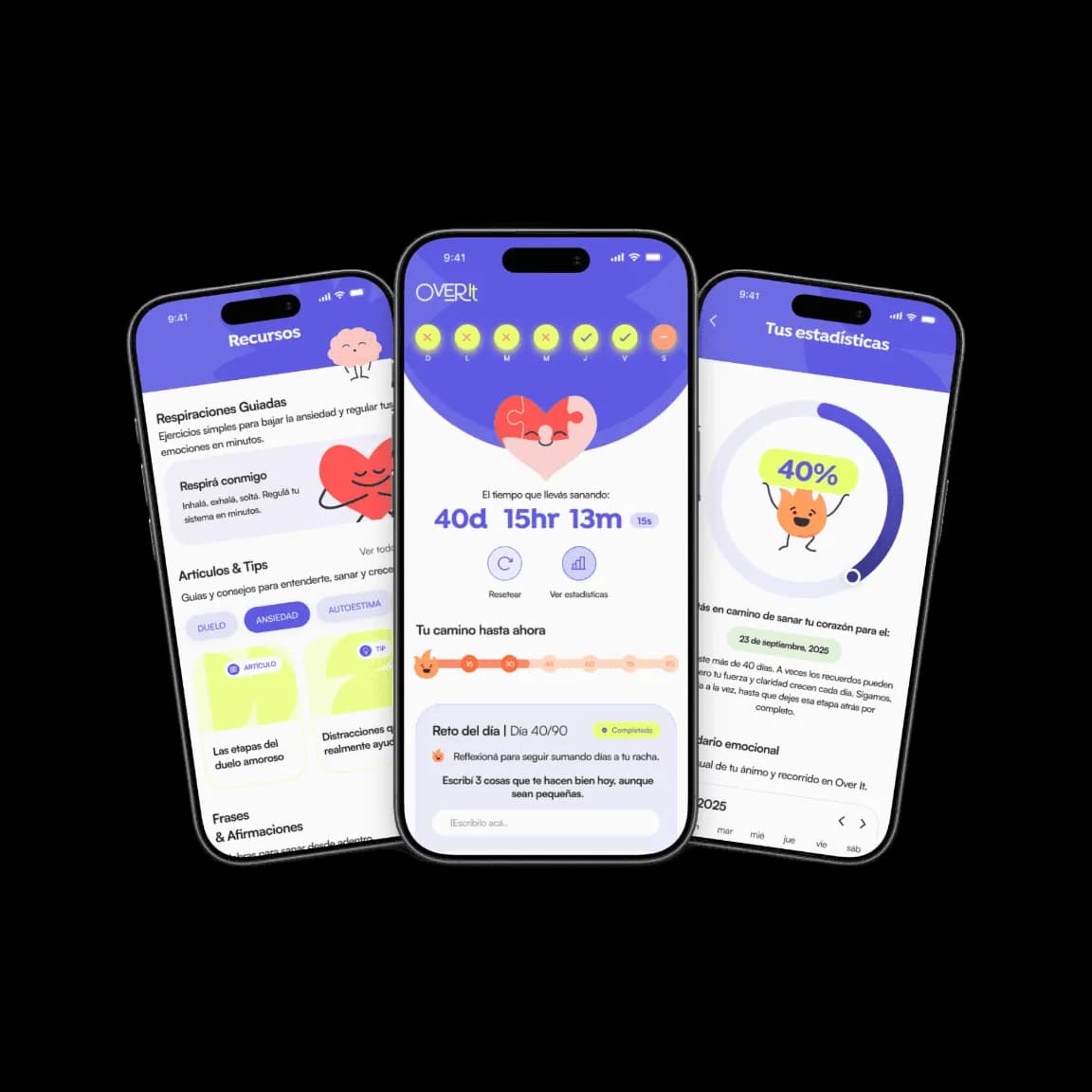
The urgent one is bargaining, because it ends in a message. The panic button in Over It is built for that minute: before it lets you write, it shows you your own reasons. If the urge is already on you, how not to text your ex is the shortest page there is.
Why does breakup grief come in waves?
Breakup grief comes in waves because it is set off by reminders rather than by time passing: a song, a street, a time of day, a date. Between waves there are stretches that feel almost normal, which is why the next one takes you by surprise and feels like a relapse.
A relationship does not live only in your head: it lives in your schedule. Each automatic habit — the time the phone used to buzz, a side of the bed, the supermarket — fires on its own and finds a gap. Shock also anaesthetises: that is why plenty of people get hit harder in week three than on the day itself.
Measuring progress by how hard the wave hits is the most common trap: one at five months can hurt as much as one on day one. What changes is how long it takes to pass: a whole day, then an afternoon, then twenty minutes. That is what the emotion tracker is for; the full clock is in how long it takes to get over a breakup.
What stage of the breakup am I in?
To work out where you are, look at which thought takes up the most hours of your day, not at how much it hurts. Replaying the scene is shock; waiting for a message is denial; rehearsing speeches is bargaining; nothing being funny is sadness.
| What takes up most of your day | Where you are | What helps most there |
|---|---|---|
| You replay the scene and it hasn't landed | Shock | Sleep and eat something. Understanding can wait. |
| You keep checking the phone for a message | Denial | Remove the shortcut: mute, archive, stop looking. |
| You rehearse perfect speeches in your head | Bargaining | Put them in your notes app. Don't send them. |
| You're angry, and embarrassed about it | Anger | Move it through the body, not into a message. |
| Nothing is funny and starting the day is heavy | Sadness | Actual company, one small task a day. |
| You think about them and the day carries on | Acceptance, in progress | Nothing special. Carry on with your life. |
Is it different for the dumper and the dumpee?
The difference is not how much it hurts — it is when the pain arrives. The person who ends it usually starts grieving months before the conversation; the person who is left starts from zero that day.
| The one who ended it | The one who was left | |
|---|---|---|
| When the grief started | Months earlier, quietly | The day of the conversation |
| What comes first | Relief, and guilt about it | Shock and disbelief |
| The thought that keeps returning | "What if I got this wrong?" | "What did I do wrong?" |
| When it hits hardest | When the relief runs out | Immediately, and again weeks later |
The one who ended it — the dumper, in internet vocabulary — gets no permission to be a mess, so their grief happens later and more alone, once everyone else has filed the subject under closed.
On the other side the trap is reading that gap as a promise: it hitting them three months later does not mean they are coming back, it means their wave arrived late. Which is why the "just checking how you are" message is not neutral: it feels like care and works like a reset.
Frequently asked questions
What are the 5 stages of a breakup?
They come from Kübler-Ross: denial, anger, bargaining, depression and acceptance. Applied to a breakup they are usually described as six, with shock at the front. They are possible states, not a staircase.
How long does each stage of a breakup last?
There is no fixed length per stage, and any figure with that kind of precision was made up. It depends on how long the relationship lasted, how it ended and how much contact is still going on. Shock is usually the shortest part, sadness the longest.
Can I be in two stages at once?
Yes, and it is the norm rather than the exception: you can be furious about how it was done and still not believe it is final, in the same afternoon.
You're going through a breakup. You're not in this alone.
Over It is a guided path out of a broken heart, one day at a time.
Keep reading
- Grief5 min
How long it takes to get over a breakup — and why there's no number
Read the guide - Grief5 min
Why a breakup hurts in your body, not just your head
Read the guide - Relationships5 min
The no contact rule: a complete guide to starting it and holding it
Read the guide - Grief6 min
How to get over a breakup, stage by stage
Read the guide - Relationships8 min
The breakup glossary
Read the guide