How to get over a breakup, stage by stage
What to do in the first 72 hours, how to hold the first 30 days together, what to do about relapses, and how to tell you're getting better while it still doesn't feel like it.
What should you do in the first 72 hours?
In the first 72 hours the goal isn't to feel better. It's to do nothing you'll regret: no texting them, no checking their profiles, no big decisions. Sleep, eat, and tell one person you trust.
Your head will ask for an explanation, and it's a trap: you don't have the information or the calm yet. If your body goes off, that's an alarm response, not something physically wrong: it's in breakup anxiety.
- Get the phone out of the way. Move the chat down, mute their notifications, take the shortcut off the apps where you follow them. For today, not forever.
- Don't spend the first night alone if you can help it. Sleeping badly makes everything harder: if it repeats, there's I can't sleep after a breakup.
- Tell one person. Saying it out loud stops it looping inside your head.
What should you do in the first 30 days?
The first 30 days are for rebuilding a minimum structure: a fixed wake-up time, one meal you cook yourself, some movement, people. This isn't motivation, it's scaffolding: with your head a mess, the day holds up on schedules, not willingness.
Thirty days won't cure you: they give the day a shape again, which is what you need right now. Week by week first, then the daily floor.
- 1
Week 1: survival
Eat, sleep, don't text them. If you also made it to work, it was a good week.
- 2
Week 2: schedules
One fixed time to get up, all seven days. The dullest thing here, and the one that changes the most.
- 3
Week 3: space
Your ex's things in a box, in a closet: you stop taking the same hit twenty times a day.
- 4
Week 4: people
Two plans with a day and a time. By now everyone else has stopped asking: you propose them.
- Get up at the same time. It's the anchor for everything else.
- One meal you cook yourself. Pasta counts.
- Twenty minutes of movement. Walking counts.
- One real human contact. A voice note, a coffee, a call.
- Ten minutes of writing. It pulls the thoughts out of the loop.
How do you keep no contact going?
No contact holds up when you make the decision before the weak moment: mute, archive the chat, block if you need to, write down why. Nobody survives it on willpower at three in the morning. It survives when there's no easy button left to press.
It means cutting off contact with your ex — messages, profiles, stories, meeting up — for as long as you decide. It isn't a punishment: while new information keeps arriving, your head can't file away what happened. The long version is in no contact.
- Mute before you block. It's enough in most cases and doesn't trigger the "you blocked me" conversation.
- Write your reasons now, while you're clear-headed. Keep them where you can find them at 3 a.m., because the version of you at 3 a.m. remembers none of them.
- Don't look at their profiles. Checking their stories counts as contact even though nobody finds out: how to stop stalking your ex works on that.
How many days has it been?
Calculated in your browser. Nothing is sent anywhere or stored on any server.
What do you do about relapses?
A relapse — texting them, checking their profiles, seeing them again — doesn't erase the ground you covered. What matters isn't that it never happens, it's how long you take to get back. Write down what you felt ten minutes before: a relapse almost never starts with your ex.
You're going to relapse, and the relapse isn't the problem: what matters is what comes after, when you decide you've ruined everything. "I lost forty days of no contact" isn't true: you sent a message, and the forty days are still there. The trigger is almost always one of these three.
- Night. Tiredness lowers the brake: the most regretted messages were sent after 1 a.m.
- Alcohol. It doesn't make you sad; it removes your ability to postpone.
- The empty stretch. Sunday afternoon, the walk home, the dead time before sleep: the hours that person used to fill.
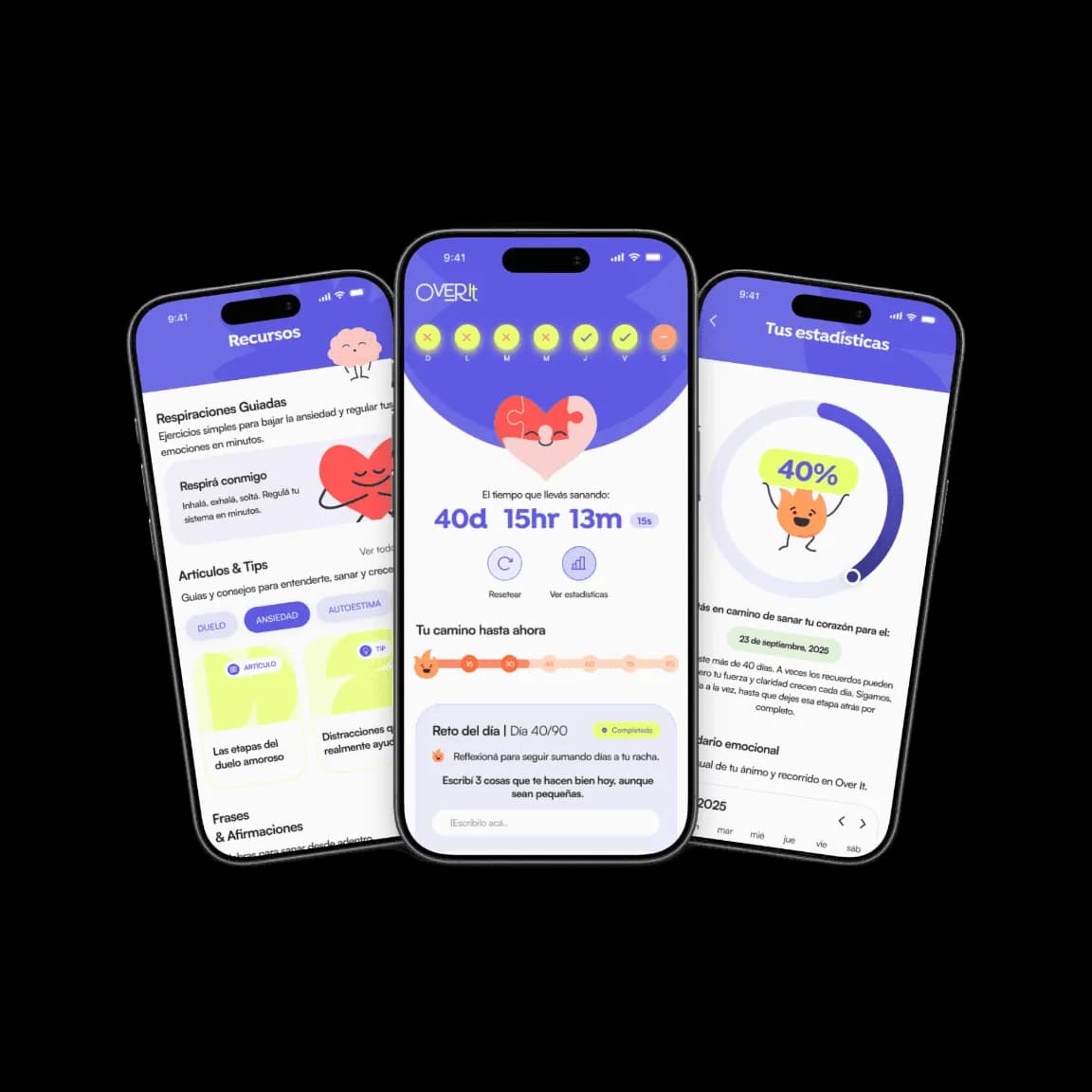
If it already happened, stop there and go back to the daily floor tomorrow. Over It has a panic button for that moment: before it lets you write, it shows the reasons you wrote down yourself. If what shows up is a head that won't stop circling, there's how to stop thinking about your ex.
How do you know you're healing?
You know you're healing when you think about your ex fewer times, less intensely, and get back to what you were doing faster. It isn't about not thinking: it's about thinking stopping to cost the whole day.
Counting how many times you thought about your ex is the worst measure there is: counting is itself thinking. The question that works is another one — how long does it take me to come back? If it used to flatten you for two hours and now it's twenty minutes, that's progress.
| Looks like progress but isn't | A real sign you're healing |
|---|---|
| You packed your calendar to the edge. | A dead stretch of time appears and you don't panic. |
| You're angry, and the anger gives you energy. | You can remember something good without it dragging you down. |
| You haven't cried in two weeks. | You cry less and get back to what you were doing sooner. |
Mood has a terrible memory: it will almost always tell you nothing has changed since three weeks ago. Writing down how you felt each day, even in one word, lets you see the curve instead of the point. Over It has an emotion tracker, and a notebook does the same.
Frequently asked questions
What's the hardest stage of a breakup?
For a lot of people it isn't the first week but the third and fourth. At the start there's adrenaline and an unreality that cushions everything; once that drops, the size of the absence lands. Feeling worse a few weeks in isn't going backwards.
How long should you stay single after a breakup?
There's no required waiting period. What's useful isn't the time but the motive: if you're looking for someone so you don't have to sit alone with what you feel, the breakup will be waiting on the other side.
Is it worth staying friends after a breakup?
It can be, but almost never at the start. Immediate friendship is usually an elegant way of not cutting: it keeps the access, the hope, and the pain on a slow burn. It works better after a long stretch with no contact.
You're going through a breakup. You're not in this alone.
Over It is a guided path out of a broken heart, one day at a time.
Keep reading
- Grief5 min
You just got dumped: what to do on day 1, day 3, day 7 and day 30
Read the guide - Relationships5 min
The no contact rule: a complete guide to starting it and holding it
Read the guide - Grief5 min
How long it takes to get over a breakup — and why there's no number
Read the guide - Relationships5 min
You want to text them: what to do in the next twenty minutes
Read the guide