Why a breakup hurts in your body, not just your head
Rejection switches on pain and reward circuits you never chose to activate. Here's what the research shows, and what it doesn't.
Why does rejection hurt physically?
Rejection hurts physically because the brain has no separate circuit for social pain. A 2003 study in Science showed that being excluded from a simple game lights up the anterior cingulate cortex, a region involved in physical pain. In 2011, researchers found that romantic rejection also activates sensory pain regions.
"It hurts" is not a metaphor you came up with to describe something you couldn't name. It's the most accurate word available, and the brain agrees with you.
Eisenberger, Lieberman and Williams excluded volunteers from a game of catch inside a scanner: that was enough to light up the anterior cingulate cortex. Kross and colleagues went further: in 40 people recently out of an unwanted breakup, a photo of their ex activated the secondary somatosensory cortex and the dorsal posterior insula, the sensory side of pain.
What happens in the brain when someone leaves you?
When someone leaves you, the brain reacts to losing something it had been treating as a need. Imaging studies show simultaneous activity in the reward system, in the prefrontal cortex and in the cingulate. It isn't one region lighting up: it's a whole network arguing with itself.
- The reward system keeps asking. It doesn't switch off because the relationship did.
- The pain system comes on. The areas that register bodily damage give the loss a physical shape.
- The prefrontal cortex tries to manage it. This is the part that knows you shouldn't text them, and it loses when you're tired or alone. Texting anyway isn't weak character.
Najib and colleagues (American Journal of Psychiatry, 2004) scanned nine women less than four months out of a breakup while they recalled their ex. The more grief they reported, the sharper the drops in activity in the insula, the cingulate and the prefrontal cortex: the worse they were doing, the quieter the system meant to help them.
Is heartbreak really like drug withdrawal?
Yes, in a narrow sense. In 2010, Fisher and colleagues published a study in the Journal of Neurophysiology that scanned 15 recently rejected people who were still in love: looking at a photo of their ex activated the ventral tegmental area and the ventral striatum, regions linked to intense cocaine craving.
The bond was never living in some romantic corner of the brain: it was living in the system that decides what to go after, the same one that handles food and water. When that person disappears, the system doesn't conclude that it's over: it concludes that the reward is late and raises the stakes.
It does have one practical consequence: if the urge runs on reinforcement, every contact recharges it. That is what sits underneath no contact. It isn't pride or a punishment aimed at the other person: it's starving the circuit.
Why does your body get sick after a breakup?
The body takes a hit because a separation works like sustained stress: sleep falls apart, appetite and routines change. At the population level it is associated with worse health outcomes; at the individual level, most people come through it well.
A review by David Sbarra (Psychosomatic Medicine, 2015) estimates that separation or divorce is associated with a 23% higher mortality rate. The same paper notes that most people cope well and that somewhere between 10% and 15% do very badly: that small group accounts for much of the elevated average, which is not your prognosis.
The mechanisms are ordinary: sleeping badly many nights in a row, eating differently, drinking more, moving less, losing the structure that held the day together. Stacked up, over weeks, the body notices. If sleep was the first thing to fall apart, there's a whole page on that: I can't sleep after a breakup.
How solid is the evidence behind all this?
The evidence is real but smaller than the headlines suggest: the key studies are functional MRI studies with samples of 9 to 40 people. They show that certain brain regions activate during rejection, not that a breakup is equivalent to a burn or to a drug addiction.
A page that tells you "science has proven heartbreak is the same as cocaine" is selling you something. Here is what the papers actually say, with names, sample sizes and dates.
| Study | What it looked at | What it found |
|---|---|---|
| Eisenberger et al. (2003), Science | Social exclusion in a virtual ball game | More activity in the anterior cingulate cortex |
| Najib et al. (2004), Am J Psychiatry | 9 women less than 4 months out of a breakup | Changes in the insula, anterior cingulate and prefrontal cortex |
| Fisher et al. (2010), J Neurophysiol | 15 rejected people still in love | Activity in the ventral tegmental area and ventral striatum |
| Kross et al. (2011), PNAS | 40 people recently out of an unwanted breakup | Activity in the secondary somatosensory cortex and dorsal posterior insula |
These are small studies, and none of them followed participants for years. What they show, they show well: there is overlap between the physical pain circuit and the response to rejection. What they don't show is how long your case will last.
Frequently asked questions
Why does it hurt more if I was the one who got left?
Because two things stack up: losing the relationship, which hurts on both sides, and the rejection itself, which is what the imaging studies measure. Whoever is on the receiving end gets both.
Why is it worse at night?
Because there is no task left to occupy your head, tiredness leaves the prefrontal cortex with fewer resources to hold back impulses, and the lack of outside input clears the runway for looping thoughts. It isn't that the pain grows at that hour: the defenses drop.
Does this mean something is wrong with me?
No. Pain showing up on a scanner doesn't make it an illness: it means the brain is processing it. It is worth talking to a professional if weeks pass and the insomnia or the hopelessness don't ease, and always if thoughts of hurting yourself appear.
You're going through a breakup. You're not in this alone.
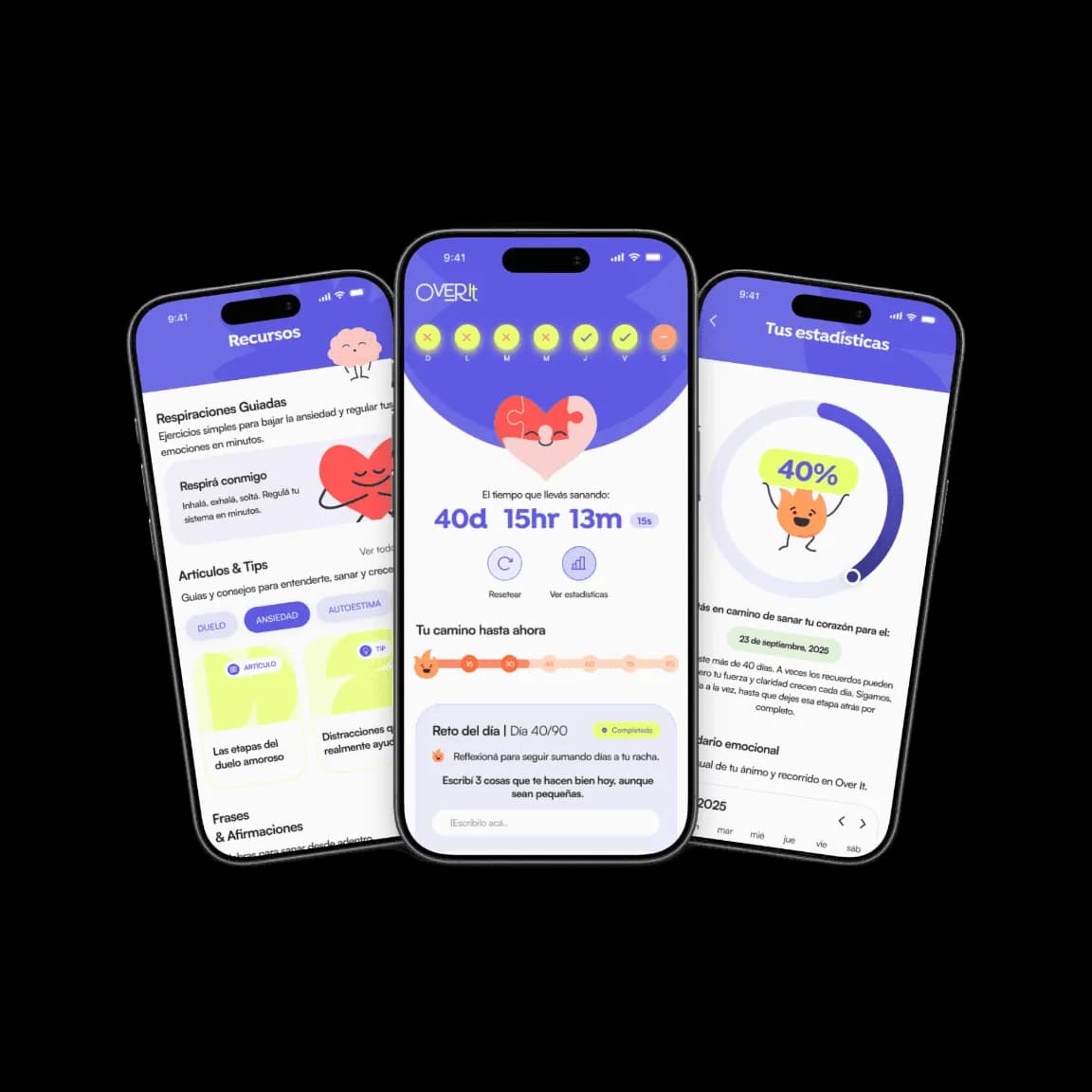
Over It is a guided path out of a broken heart, one day at a time.
Keep reading
- Grief5 min
How long it takes to get over a breakup — and why there's no number
Read the guide - Relationships5 min
You want to text them: what to do in the next twenty minutes
Read the guide - Relationships5 min
The no contact rule: a complete guide to starting it and holding it
Read the guide - Anxiety5 min
Anxiety after a breakup: what's happening in your body
Read the guide - Relationships8 min
The breakup glossary
Read the guide